
Our services
MRI
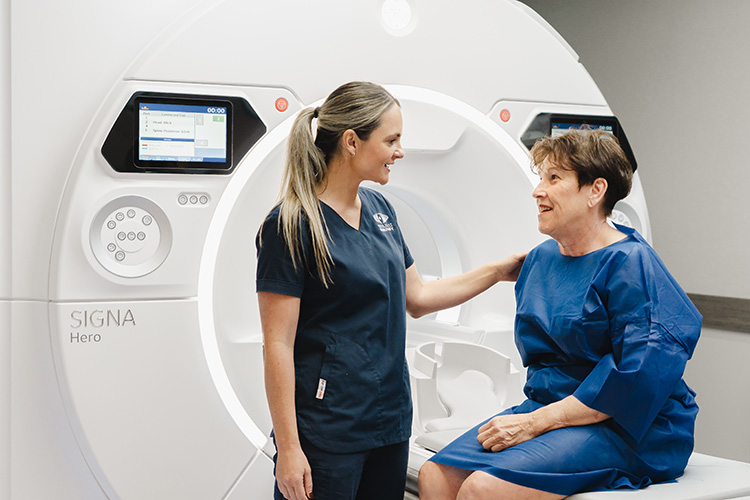
At South Coast Radiology, our MRI service uses advanced high-field scanners and specialised imaging protocols to deliver exceptional soft-tissue detail — all without exposing patients to ionising radiation.
MRI allows our radiologists to visualise internal structures in remarkable detail, making it a vital tool for diagnosing, monitoring, and planning treatment across a wide range of conditions — from neurological and musculoskeletal to oncological and vascular.
What is an MRI?
MRI (Magnetic Resonance Imaging) uses powerful magnets, radiofrequency pulses, and computer technology to create detailed cross-sectional or 3D images of your body’s internal structures.
Rather than X-rays, MRI relies on how hydrogen atoms in your body react to magnetic fields and radio waves.
The resulting signals are processed to reveal subtle differences in tissues, making MRI highly effective for identifying inflammation, nerve compression, soft-tissue tears, and other internal abnormalities not visible on X-ray or CT.
Why is MRI done?
Your doctor may recommend an MRI to investigate or monitor a wide range of conditions, including:
- Neurological evaluation – brain, spinal cord, nerve compression, multiple sclerosis
- Musculoskeletal imaging – ligament or tendon tears, joint injuries, cartilage damage
- Oncologic imaging – tumour detection, staging, or treatment monitoring
- Abdominal & pelvic imaging – liver, kidneys, pancreas, uterus, prostate
- Vascular imaging – arteries and veins using MR angiography (MRA)
- Cardiac imaging – assessing heart structure, function, and blood flow
- Pre-surgical planning – mapping anatomy and pathology for surgery or intervention
MRI often provides additional clarity when other imaging such as CT or X-ray is inconclusive.
Types of MRI
We perform a comprehensive range of MRI studies at South Coast Radiology, tailored to your clinical needs and referring doctor’s request. Each study uses tailored sequences and imaging techniques to answer specific clinical questions and provide the highest diagnostic value.
About Your Test

Before your appointment
- A valid referral is required.
- You’ll complete a detailed MRI safety questionnaire before your scan.
- Inform staff if you are pregnant, claustrophobic, or have any implants, metal fragments, or pacemakers.
- Some scans may require fasting or specific preparation (we’ll advise at booking).
- Avoid cosmetics, hair products, and clothing with metal fasteners.
- Bring previous imaging (CT, X-ray, or MRI) for comparison.

On the day
- You may be asked to change into a gown; lockers are provided for your belongings.
- The procedure is painless. You’ll lie on a cushioned table that slides into the scanner.
- Earplugs or headphones are provided as the scanner produces loud sounds.
- You’ll have a communication buzzer for reassurance and support throughout.
- Some scans may involve an intravenous contrast injection to enhance detail.
- The scan typically takes 15–60 minutes, depending on the area and complexity.

After your appointment
- You can resume normal activities immediately.
- If contrast was used, drink plenty of water to assist clearance.
- Our radiologists interpret your images and send a detailed report to your doctor.
- You may also access your images digitally through our secure patient portal.
Frequently Asked Questions
Preparation depends on the area being scanned. We’ll give you clear instructions at the time of booking.
Some MRI scans require contrast (gadolinium). It’s used only when clinically needed and safe for you.
We can arrange mild sedation (with your doctor’s approval) and provide reassurance during the scan.
MRI is generally safe after the first trimester, especially if no contrast is required.
Yes, many are. Your referring doctor will advise if your scan is eligible.
Safety & Considerations
MRI is very safe for most patients. It does not use radiation; however, it’s unsuitable for some individuals with non-MRI-compatible implants or severe claustrophobia.
For patients with kidney impairment, contrast use will be carefully reviewed before proceeding.
If you have any of the following, please inform our team when booking — we’ll ensure the appropriate safety checks and comfort measures are in place:
- Implanted medical devices (pacemakers, stimulators, clips, etc.)
- Metal fragments in your eyes or body
- Claustrophobia